Southbound

Oct. 2nd, 2011 02:38 pm
tim: 2x2 grid of four stylized icons: a bus, a light rail train, a car, and a bicycle (travel)
As I drive from your pearly gates
I realize that I just can't stay
All those mountains, they kept you locked inside
And hid the truth from my slighted eyes

I came to you with a half-open heart
Dreams upon my back, illusions of a brand-new start
Nashville
Can't I carry the load
Is it my fault?
I can't reap what I sow
Nashville
Did you give me half a chance?
With your Southern style and your hidden dance away
And you dance away and you dance away

All these voices, they whisper through my walls
They talk of falling fast, they say I'm losing it all
They say I'm running blind to a love of my own
But I'll be walking proud, I'm saving what I still own

I fell on my knees to kiss your land
But you are so far down, I can't even see to stand
Nashville
You forgot the human race
You see with half a mind
What colors hide the face
Nashville
I'd like to know your fate
I'd like to stay awhile
but I've seen your lowered state today
I've seen it today, honey
I swear I've seen it today

Now I'm leaving, I got all these debts to pay
You know we all have our dues, I'll pay 'em some other place
I never ask that you pay me back
We all arrive with more
I left with less than I had

Your town is made for people passing through
A last chance for a cause I thought I knew
Nashville
Tell me what you are gonna do
With all your Southern style, it'll never pull you through
Nashville
I can't place no blame
But if you forget my face
I'll never call your name again
No, never again
Oh, never again

I fell on my knees to kiss your land
But you were so far down and I can't even see to stand
Nashville
You forgot the human race
You see with half a mind
What colors hide the face
Nashville
I'd like to know your fate
I'd like to stay a while
But I've seen your lowered state today
I've seen 'em today, honey I swear I've seen 'em today
I'm running away, I'm running away
I'm running, I'm running, I'm running away


-- Amy Ray
tim: Tim with short hair, smiling, wearing a black jacket over a white T-shirt (Default)
I'm giving away the following shirts. I will pay for postage (if you like what you get, just make a donation to your favorite gay-baby-seal-loving charity -- but not the HRC) -- just leave me a comment with your mailing address and (if I don't know it already) name. Comments are screened. Offer valid even if I don't know you! It's all good!

1. "Intellectual Slut", white on black, size L but it's an American Apparel "Standard American" so it's more like a men's M at best. I used to love this shirt but now that people perceive my gender differently, I don't think it's all that cool for me to wear "slut" on my proverbial sleeve anymore.

2. "feminists do it better", white on black, size L American Apparel "Classic Girl", so it's sleeveless. Love it, but doesn't fit me anymore.

3. "master of my domain", white with an orange graphic of, well, a graph (hyperbola) on a dark brown shirt. Size L "No Star" brand, but it actually seems more like a men's S. Only worn a few times, doesn't fit me anymore.

4. "Everything else is just dysfunctional programming!" shirt with a list of functional programming languages, green/gray text on white, size L. You can see the crisp new version on CafePress, but since it's a CafePress shirt, the background of the design is discolored slightly since it was a transfer. Still legible. I don't feel like I can reasonably wear this shirt anymore since I work on evil non-purely-functional programming.

5. "If You Drink, Don't Drill!" Life in Hell shirt (it says "Life in Hell" on the back) featuring Binky. Men's XL, black design on white. This shirt is awesome, but my bunnies ate part of it and I cut out the collar area, resulting in a rather revealing neckline. After much thought, I've decided I don't want to wear such a risque shirt anymore. But it works fine over a black turtleneck or something. Definitely on the verge of falling apart -- only for those diehard Matt Groening fans (or possibly for turning into a pillow or something if you're crafty).

Image of all the shirts

If I've offered one of these shirts before and you requested it and I forgot, then I apologize! Please request again.

Also, if you're reading this on Facebook, comments will not be screened. Private-message me your contact info if you don't want the world to see it.
tim: Tim with rainbow hat (pic#148316)
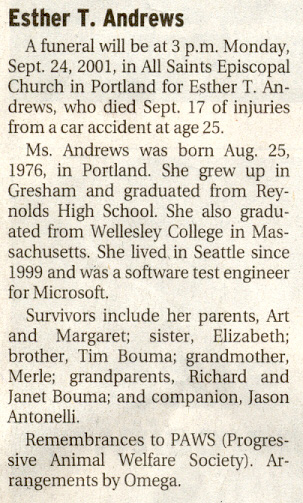
Esther died ten years and two days ago. Five years ago, I wrote "It's rare for a day to go by when I don't think of her." Sometime in the past five years, that stopped being true. The last time I wrote about Esther here was four years ago. So it's important for me to mark this day once more (even if it's two days late), because forgetting what she meant to me would be forgetting something central.

Esther would have been 35 now, which is inconceivable. I'm five years older now than she ever was, which is inconceivable now. How can it be that I know so little when she seemed to know so much? She has now been gone for twice the amount of time for which I knew her. When I think about how this person who knew so much about me at a time when very few people knew anything about me is no longer in the world, and will never come back, I feel lost. It bothers me not being able to say more, and it bothers me how much of what I can say is about me more than it is about her. What is left to say?

Nothing, except the same thing I said a year after: She was my friend. I loved her. I miss her. What would I do just to have the chance to say goodbye?
tim: Tim with short hair, smiling, wearing a black jacket over a white T-shirt (Default)
I cannot tell you how many times I have been told the following: “I have no problem with you people dressing however you want, and I’ll even call you ‘she’ if that’s what you want, but if you go around hitting on guys, don’t be surprised when you get what you deserve.” The threat of violence there is implied in only the loosest sense; no rational person in the threatened group would interpret that as anything but a threat. At the very least, it is condoning it as deserved.
-- Autumn Nicole Bradley, "Larry King is why L, G, B, and T are together"
Go ahead and call it abuse. Call it assault. Call it rape. If you've done a whole lot of waffling about your experience with not-very-niceness, it probably was whatever you don't want to call it. It'll give you a sense of legitimacy when you feel hurt or angry. It'll give you, and the people you disclose to, a cue to take your experiences and their impact on your life seriously. It doesn't "cheapen" anything--do you think it's wrong to call influenza "illness" because really ill people have cancer oh my god don't cheapen the I-word like that? And it'll stop you doubting or devaluing your own emotions. If you survived something painful, you're a survivor, and it's not drama but simple fact to say "I'm a survivor."
-- The Pervocracy, "Survivor"
tim: "System Status: Degraded" (degraded)
Part 1 | Part 2

Part 3

"there is some shit I will not eat."

-- E.E. Cummings

So let me summarize: one student in my research group harassed another student in our group; the harasser was rewarded for his behavior, and the victim suffered. I think that's unfair.

I said as much to the three faculty members in the group. The responses I got ranged from silence to hostility. In particular, Andrew Tolmach -- who is both my advisor and Thomas's advisor -- told me that he didn't know the details of what Thomas had done, and he didn't want to know. He also rejected an idea I had proposed -- of one of the faculty members in the group making a public statement that someone had done something really bad to our group, and explaining what would be done about it -- because he said that making it about Thomas in particular would be a "witch hunt". (I'm not sure whether he realized the irony of invoking a historical event consisting largely of the persecution of women -- some say largely queer women, at that -- to argue against holding a man accountable for persecuting someone for being queer and feminine.) Later, he told me that he didn't think sexual harassment was an academic issue, and therefore nothing that Thomas had done was any of his business. I explained that I disagreed, that I thought that when one student intimidates another student out of being able to do their job, that is an academic issue. He also said that he didn't think there was anything special about sexual harassment as opposed to harassment in general, and he didn't think that the genders of the people involved made any difference in its severity.

Legally, the precedent seems pretty clear to me: all workers in an organization who are in a supervisory position -- such as a professor who advises graduate students, supervising them more closely than, for example, many managers at a software company would supervise their employees -- are responsible for pro-actively preventing sexual harassment in the workplace, and for being aware of any ongoing issues that make the working environment a hostile one. Ethically, I don't see how it's possible for sexual harassment of a colleague to not be an academic integrity violation. In a lab science field, it would be an academic integrity violation to take out your competition by sabotaging their experiments. In any field, it should be an academic integrity violation to take out your competition by letting them know they don't belong and eroding their dignity. If I were a supervisor, and I had a student (or employee) who did this, to me that would feel like a betrayal and a violation on the same level as plagiarizing or falsifying experiments.

I guess, though, if you occupy a social stratum where sexual harassment doesn't -- and can't -- affect you, it's easy enough to pretend that it doesn't affect anybody, and that if it does, they're just being too sensitive. Sexual harassment, directed at a woman by somebody who has male, heterosexual, and cissexual privilege, is fundamentally different from a woman harassing a man, in the same way that hitting someone with a baseball bat is different from hitting them with a pillow. The reason is that in the first case, it's not just one person saying something that one other person finds gross or disgusting or crass -- it's somebody leveraging all of the power of a sexist, heterosexist and cissexist society, all of the tacit knowledge and shared assumptions that mean that with just a few words, if you've got male privilege, then you can put a person in your own socioeconomic stratum in their place with just a few simple words (as long as they don't have male privilege). Sometimes it's words like "bitch" and "cunt", but you can use more polite words to get the same effect. What's important, more than the specific words, is that you invoke the image as woman as being for sex, as not being good for anything but to provide sexual pleasure to a heterosexual man. Since part of all of our cultural inheritance is that the idea that anyone who is capable of providing such pleasure is just a whore, and only a whore, and incapable of being a competent worker or anything other than whoredom, men with cis- and hetero- privilege who want to use their power barely need to do more than just point at that cultural inheritance. A woman could say all the same words to a man, but it wouldn't have the same hurtful effect, because we simply don't have the infrastructure in our minds for such words to become a speech act. It would just seem laughable. (If you ever present yourself femininely, you can try this the next time some guy in a car asks you what you're doing tonight.)

I decided, though, that since Andrew had told me that it wasn't his job to ensure that his students didn't sexually harass their colleagues (or to express disapproval when they did), I had to make it my job to protect myself from being sexually harassed if I returned to the department. Let me remind you of how this affects me:

  • Knowing that it's tolerated in my department for a student to harass a GSM member, and that this will be met with neither personal consequences to the aggressor nor an institutional response, makes me feel like I'm not welcome, because it seems to show pretty clearly that my contributions aren't valued as much as those of privileged students.
  • Even if I'm never harassed myself, I'm not comfortable in a place where I will have to witness women or genderqueer people being harassed and where I'll be shamed or silenced if I try to talk about it with authority figures.
  • Seeing someone hurt my friend, and getting a response that basically says my friend isn't valued either, hurts.
This doesn't just hurt my feelings -- it makes it impossible for me to do my job. To do my job, I need to be able to trust that the people I work with will hear me if I have a complaint about how somebody else is treating me. I need to know that they won't automatically side with somebody because they can empathize with them better (being more socially similar) or because that person has higher status. Without being able to trust in those things, I can't feel safe. Every situation could be a new trauma just around the corner. I can't take risks. I'm less likely to go out and socialize with other students, because I don't want to be harassed, and I don't want to it escalate it into something that will also affect life in the office. That deprives me of the informal connections that are necessary to succeed in academia. It also makes me feel more lonely and isolated.

So, I told Andrew that I would be willing to return in the fall if three conditions were met: (1) that I would do all my work off-campus, except for attending meetings where faculty members were present; (2) that I wouldn't have to speak to Thomas, including interacting with him about project work; and (3) that it would be acceptable for me to do one internship per year (this was unrelated to the first two conditions, but relates to the skyrocketing cost of PSU student health insurance. For fear of making this really tl;dr, I'll omit the reason why I had to stipulate that). He rejected all three conditions, stating that regarding item (2), he expected all group members to be "collaborative and respectful" towards one another.

I asked whether he thought that making an unwelcome sexual advance towards a colleague was "collaborative and respectful" behavior in his opinion, and he refused to answer.

If I take these comments at face value, that means he's asking me to work under conditions that make it impossible for me to work. I can't smile at an abuser and pretend that everything is okay. That would take all the energy I have. I can't write a dissertation while hating myself and feeling like a hypocrite every day. And I can't get up every day to do hard intellectual work while knowing that going to work could make me a target for a bully, and if I became one, all that the faculty members would be concerned about was ensuring that the bully got an education. Doing my best not to appear angry would be a betrayal to myself and to the people I care about.

But I really can't take these comments at face value. I can't see how he can tell me with a straight face that it would be disrespectful to not be polite to a sexual harasser in the corridors, when nothing more than a (privately administered) slap on the wrist was ever done to let everyone in the department know that this is not a place where bullying people in minority groups is okay. How is that respectful to me or to Alice? It seems that there is a double standard.

Andrew can refuse to answer the question of whether hitting on somebody at work is "collaborative and respectful" because he doesn't know the details of what happened and can't judge whether it was respectful or not. But he chose not to find out the details, in order to spare himself from having to take a stand one way or the other. There's something unpleasantly circular about that. I thought Andrew was a good advisor because he always stressed the importance of intellectual honesty -- how, in research, you always have to be brutally honest and admit when you don't know something or when you've made a mistake. For me, those principles extend beyond the pages of a conference paper and into professional and personal relationships. I guess for him, they don't. And I'm disappointed.

If I go back to PSU, I'll have to look for a new advisor, and I'm not sure who that would be, so I don't know whether I'll ever go back. I also don't yet know what my future plans are, as my internship at Mozilla ends on September 9, this coming Friday. I've filed a complaint with the Diversity office at PSU, and I'm in touch with some folks at the civil rights group Basic Rights Oregon to find out about recourse. I have to say, though, that even if I "won" a case -- whatever that would mean -- it's hard to imagine voluntarily returning to a toxic environment, and it's hard to imagine how that environment could be cleaned up when there isn't a single person with any power to clean it up who wants to. That is, not a single person who has done anything to do so, as opposed to saying they want to.

My goals in writing this and making it public don't include effecting any concrete change. When understanding a situation would compel a person to action, and it's easier not to act, then it's in their interest to not understand. So, I don't really have a rational reason to have written any of this, except that I think if I don't put it in writing, I will lose what remaining ability I have to get out of bed in the morning, concentrate on my job, not channel my rage into snarky comments on Reddit, and otherwise be a functional member of society. When people try to silence me, it's an excellent way to get me to tell everybody everything.

Finally, I want there to be a public record of why I left grad school. It's well-documented that faculty members usually take credit for their successful students' accomplishments while blaming non-completing students for their own difficulties. I left because I didn't have the energy to fight bullying from students and poisonous apathy from faculty members. I wanted to go to a place where I can do my job and be productive, and if where someone decides to intimidate me because I'm fat or because I love men or because I was coercively assigned female at birth, I can have confidence that my supervisors will be completely behind me.

I've wondered whether the faculty think they are being "neutral". And if so, I wonder whether they understand that in the presence of a bully, neutrality means siding with bullies; not taking sides means that someone who is abusing their power will continue to do so unchecked. Perhaps they imagine it's their job to side with a student who may have been "falsely accused" of some wrong. But there's a conflict here between giving the benefit of the doubt to someone who's been accused of something, and believing people who are systematically disbelieved. When you choose to do the former, you're identifying yourself as part of a social pattern that disbelieves women, trans people, queer people, and other people in minority groups (because after all, women are emotional, trans people are deceptive, queer people are abnormal, and God help you if you're all of the above). That's not exactly fair.

If you're still thinking that harassment between supposed equals isn't harassment, consider how with a conversation that took less than five minutes, Thomas managed to derail two people's lives for six months or more. What should have been a small action got a lot bigger due to the complicity of those who had the power to condemn it, and chose instead to deny or make excuses. In the past six months I've learned that when people say they want to help and be supportive, there's generally an unsaid postscript of "but only when it's easy for me and when I don't have to take a stand".

Of course, some of the work was done for him already by the life experiences that Alice and I have both had as queer trans people living in a profoundly repressive, cisnormative, heteronormative society. But that's exactly what power is -- having that entire society behind you. If I could have reclaimed the time I've spent thinking about this situation, and talking with others about it, I might have a completed dissertation proposal by now. Just today, I spent about 4 to 5 hours -- while on vacation -- drafting this post. I could have gotten some solid work done on the research paper I'm working on. But that's how it is, eh? When you have the privilege of not having to care, it frees up a lot of time to have fun thinking about interesting problems and being successful.

And that's why analyzing power dynamics isn't useless theory. For some people, it might seem that way, because you don't need to think about power when you have it. But this is my life. I need to document what's happened because I can't think clearly about anything unless I write about it, and I need to think clearly about it so I don't blame myself. If I blame myself for not being able to graduate, I'll have lost my sense of defiance. Sometimes I think that's all I've got.

"Even if you're a woman who wasn't abused, you're fucking angry because people treat you like shit all of the time, even if it's those tiny little things that don't matter immediately. Those little acts of violence just build and build and you have to choose to either internalize it and hate yourself or get MAD and do something about it. So you do get mad -- you get more angry than you've ever felt before, because you've never had the chance to even say how you feel and have those feelings acknowledged as worthy and awesome. You get angry because anything else, any compromise or giving up or hiding or pushing things deep down and ignoring them -- it's total self annihilation. You have to get angry, or else the thought of living in such a world becomes unbearable."

-- Chungyen Chang

Epilogue

Knowing that I'm leaving and Alice has chosen to stay and fight shouldn't diminish the seriousness of either of our struggles. I decided that for me, the reward of getting a Ph.D wasn't worth the pain of having to do other people's emotional work and to fight every day to be seen as a person too. I was willing to endure almost anything to gain entry into the privileged fellowship of those who can show they deserve autonomy and freedom on the job, not to mention working in a field I love -- but the price, for me, was too high. Alice loves their work enough that it was worth it for them to stay, to endure, to exercise more strength and deal with more awfulness than most people in our profession can probably imagine. And for them, that's the right thing. Alice's colleagues might say, right now, that Alice "seems fine". If they do say that, it's because of the incredible amount of extra work Alice has done, is doing, and will do, to "seem fine" after having to deal with what no one should have to deal with.

The thing is, though, that both of us had to choose: choose between staying and dealing with conditions that have a disparate impact on minority group members like us -- conditions that mean we have to work that much harder to get the same (or lesser) reward -- or leaving and losing out on one more opportunity. Privileged people don't have to make choices like these. Choice isn't always good: not when either choice you make will be criticized. Stay, and you're criticized for participating in an oppressive system. Leave, and you're criticized for letting the bullies win. You can't win. I hope that no one reading this will conclude that I gave in by leaving or that Alice gave in by staying. That wouldn't be fair, because we're both in a no-win situation.

Postscript: Alice read a draft of this post before I posted it, and gave me their permission to post it publicly. I have not sought permission from any of the other people named in this account, as I believe their actions constitute implicit consent to such naming.

Comments on this post are screened by default. I will unscreen comments that I find to be constructive, unless you tell me "Please don't unscreen my comment". Edited to add: Please feel free to link to this post anywhere you feel fit. There's no need to ask permission. I don't mind having to deal with a few trollish comments as a result; screening means I'm the only one who has to see them.

tim: "System Status: Degraded" (degraded)
Part 1

Part 2

"There's a difference between blaming the community and not the attacker, and holding the community accountable for enabling the attacker to be there."

-- "I Wish I Could Safeword Rape Culture"

I'm not returning to grad school this fall. This would have been my fifth year in the Ph.D program in the Computer Science department at Portland State University. I've been employed by the university as a research assistant for all four years (which means getting paid for the work you would do as a grad student anyway). I passed my Research Proficiency Exam two years ago and was second author on a conference paper a year ago. If I were returning, I would probably be defending my dissertation proposal sometime before the end of 2011, and assuming that my committee didn't see any major flaws in my plan, then I would achieve all-but-dissertation (ABD) status. But now that's not going to happen. I've written to the Office of Graduate Studies to request a leave of absence, and I already have the approval of the chair of the Computer Science department. With that said, I don't know if I'll be returning when that leave of absence is over. For me to return, some serious problems will have to be addressed, and honestly, I don't see anyone who has both the power to address them and the desire to do so.

I don't feel like returning was a serious option for me. On August 12, my advisor told me that if I returned, I would have to fulfill a set of conditions that would make it impossible for me to do my job. I can't fulfill these conditions because to do so, I would have to spend so much of my time doing emotional labor to compensate for others' lazy, self-serving attitudes, I wouldn't have any time left to do research. He then closed the letter by saying he hoped I would be able to finish my Ph.D. So I have to assume that his intentions were good -- see, there's that word again! -- but that doesn't really help me. In fact, that makes it harder, because when I know someone hates me, I know where I stand. On the other hand, if I have to untangle a mixture of malice, fear and laziness, well, it's just yet more unpaid work for me.

But let me explain.

On February 8, I witnessed Thomas Dubuisson, another grad student in my department, make a sexual advance towards a third student in our group, "Alice", in our grad student office. ("Alice" is a pseudonym. Yes, I'm withholding the victim's name but not the aggressor's name, which seems fair, since the victim got victimized whereas the aggressor didn't. What also needs to be said -- because it's relevant to the story -- is that Alice prefers gender-neutral pronouns now, so I'll use those pronouns to refer to them. However, at the time when the incident happened, they were identifying as a woman and had requested that feminine pronouns be used to refer to them. This was nine months after Alice came out to the department as trans and publicly announced their preference for a chosen name and for feminine pronouns.) The advance was unwelcome because both Thomas and Alice were and are married; while there is certainly space in this culture for dating a person who is married to someone else, it's best dealt with delicately and not in a workplace. By the "reasonable woman" standard used in sexual harassment law, Thomas's remarks qualify as something that a reasonable woman would find unacceptable. I think so, Alice thinks so, at least one independent expert thinks so. So let me be absolutely clear: Alice should not have been expected to say, pre-emptively, "I don't want you to make a sexual advance towards me at work." Thomas should have known that it would be wrong.

This incident followed a series of inappropriate remarks by Thomas -- mostly directed at Alice -- that began even before Alice came out as a trans woman, but escalated after that happened. While I also don't enjoy being told (during lunch at work) that I'm not normal because I'm not heterosexual, the incident of February 8 was the most blatantly inappropriate one that I witnessed. I'm going to be very clear here and say that I didn't even respond appropriately myself at first. But, after talking with Alice, and upon more reflection, I slowly realized what had really happened. In the only conversation that Thomas and I had about it, Thomas told me "I just thought it was funny." This is another example of disparate expectations for emotional work: in-group members are allowed to excuse any of their behavior under the umbrella of "humor", whereas if out-group members don't find jokes at their own expense to be funny, they need to "get a sense of humor". They need to do the work to improve their senses of humor (that is, to learn to treat themselves as worthless except as fodder for the meanest, most mocking sort of putative humor -- actually, that's one of the things marginalized people often least need to work at).

Now, I hope it should be obvious to you that an unwelcome sexual advance doesn't become acceptable in a workplace if you say it was just a joke. In general, you can't say something completely wrong and unacceptable and justify it with "I was only joking". Right?

Right???

Just in case it isn't, let's review some basic feminism. (People who have taken Feminism 101 or done equivalent independent study can probably skip the next paragraph or two.) Sexual harassment is frequently misunderstood because people think it's about sex, or about being offensive or crass, or about hormone-crazed men (trans men are always absent from the picture, of course) who can't control their behavior. In reality, sexual harassment is just a form of bullying for people who've gotten tired of sticking gum in the other kids' hair. Sex has very little to do with it -- it just so happens that using sexual references or behavior to reduce a woman to the status of a sexual object is a pretty effective way for a man to bully a woman. It's about putting an uppity woman in her place (reminding her that women are good for sex, and nothing more, and if you're good for sex, you can't be good at anything else); it's also a threat. I think anyone who's spent more than 5 minutes being perceived as a girl or woman over the age of 11 understands that "I want to fuck you" turns into "I'm going to fuck you" pretty quickly, and from there the jump to "whether you like it or not" can happen in no time. Many women are never raped, most women who are raped experience it only a handful of times, but in a sense it doesn't matter because the threats are constant, and women are trained to live in a state of hypervigilance of these threats. (Again, it doesn't really matter whether you were socialized "as a girl", or "as a boy", whatever that means; if you know you're female, you know these messages are addressed to you. And if you're a man or a genderqueer person who doesn't identify as male or female, but people regularly see you as a woman, you know these messages are addressed to you, too.) This is called "rape culture", and it's a labor-saving device for men who need to show that they have power over women. They can simultaneously avoid actually raping (usually), while accomplishing much of the work that rape does (keeping women in a state of fear), by stopping at "I want to fuck you" or at comments, looks or gestures that communicate that message.

Now, when someone who's socially recognized as a trans woman is involved, what happens is an intersectional cluster-you-know-what, because to the extent that a person is seen as a woman, that triggers rape culture; to the extent that they're also seen as trans, that triggers discomfort and desire to intimidate, especially on the part of heterosexual men who feel threatened by the presence of someone who they find attractive, but who they also believe is pre-equipped with a penis. For guys with a heteronormative, cisnormative worldview, what that often turns into is intense desire to get them out of the way -- sometimes through intimidation, sometimes through less pleasant tactics. Finally, popular culture -- when it represents trans women at all -- represents them as sex workers, porn stars, or in other roles where they are seen as purely sexual objects. Even more so than for a cis woman, bringing up a trans woman's presumed sexual receptivity is a way of telling her she doesn't belong here (whether "here" is at work, at school, in church, or so on).

(I am, by the way, not particularly interested in debating those last two paragraphs. If you're tempted to argue with those particular points, please familiarize yourself with the last half-century of thought within various schools of feminism, and then we'll talk. To quote Chungyen Chang again: "if you don't know... then you've chosen not to". If you chose not to because you found other things more interesting or because you think violence against women doesn't affect your life, then that's still a choice.)

Furthermore, faculty members later told me things like: "he's just clueless, he didn't know how to act around a trans person, he was confused and had never dealt with someone who was transitioning before." Well, let's think about some of the things that bullies do:

  • They wait to do their bullying until no authority figures are present; when authority figures are around, they can behave like perfect gentlemen. (They know how to behave appropriately, in other words -- they just choose not to do so when they're not being watched.)
  • They choose a target who's terrified of complaining to authority figures, and is unlikely to let anyone know what's being done to them.
  • They choose both the target, and any witnesses, from politically marginalized groups (like women and trans people), so that if the target and witnesses complain, their stories won't be believed.
  • They exploit people's triggers.
So no, I don't think Thomas's behavior was clueless: I think his behavior shows that he's a skilled bully, and possibly an experienced one. Explaining it away isn't acceptable.

You might also say that two grad students are equals, so it's not possible for one of them to sexually harass another. I think the ending of this story shows how false that is: two people might have equal occupational rank, but if one of them is a member of social groups that everyone in charge is inclined to identify with, and the other is in groups whose members are widely considered to be subhuman and undeserving of empathy, there's a power imbalance. There's also a power imbalance insofar as we're all -- even, especially those of us who grow up gender-variant -- taught to consider gender and sexual minority members to be undeserving of empathy. We learn to do it so well that we do it without even thinking about it. And that's another reason why intent doesn't matter. To paraphrase Samuel Delany, there's no need for anyone to make a transphobic decision; all the transphobic decisions have already been made, and all it takes to perpetuate them is to do nothing.

Accordingly, I would also think that if a grad student feels it's appropriate to bully another student in this way, he did not come up with this idea in a vacuum. If somebody thinks that it's appropriate to act this way in a workplace, and that they can get away with it and keep their job, that has to be a problem with the environment. Ph.D students are supposed to be intelligent, mature people. This isn't grade school. People only do things like what Thomas did if they think there will be no consequences for themselves.

And... it turns out he was right. There were no significant consequences.

Alice took an immediate leave of absence, beginning a couple days after the 8th of February. They were on leave for the Spring term and missed the once-a-year opportunity to take the RPE, which Ph.D students at PSU take in their second year. As a result, they will be a year behind other students who started at the same time. Thomas was not required to take time off. He took the RPE. He was able to make academic progress. He didn't even have to have his working relationship with his academic supervisor disrupted. As far as I'm aware, the only consequence to Thomas was that he was asked not to approach Alice again or talk to them at all, about anything, even work. (I've been told that for privacy reasons, I can't be told all of the details of what action was taken. I can only conclude from this that nothing was done, except for the one request that I know about. I wish I could have been excluded from the events of February 8 in order to protect myself and my privacy -- not to mention my emotional health -- but since that didn't happen, it doesn't seem fair to me to not know what kind of justice, if any, was done to the person who did the harm.) Thomas ignored this request, and as far as I know, no consequences arose from his violation of the request. The only thing that's different in the department now is that I won't be in it.

Part 3

Comments on this post are screened by default. I will unscreen comments that I find to be constructive, unless you tell me "Please don't unscreen my comment".

tim: "System Status: Degraded" (degraded)

Prologue

I haven't been posting much in the past few months. My time has been occupied being angrier than I've ever been before in my life. Besides the minimal energy I've been able to spare to do my paying job, most if not all of my intellectual energy has gone into composing (in my head) what you're about to read. I haven't worked on my dissertation or read research papers, much less worked on any hobbies. I haven't worked on any open-source projects for the fun of it (besides the one I'm getting paid to work on). This has been it.

Part 1

"I cannot hide my anger to spare you guilt, nor hurt feelings, nor answering anger; for to do so insults and trivializes all our efforts. Guilt is not a response to anger; it is a response to one's own actions or lack of action."

-- Audre Lorde

Today is Labor Day in the US. I want to write about the emotional labor that I have to do just to do the usual things people do -- have a job, have friends, study -- and be a trans person. When I say I'm trans, it means -- for the purposes of this discussion -- that people don't, universally, recognize my sex and gender as valid. And the more power someone has, at least in the place and time where I live, the less they tend to recognize my sex and gender as valid. The number of fucks I would ordinarily give about this approaches zero asymptotically, but unfortunately, when people have power over you, you have to care what they think. Because what they think affects what they do, and what they do affects things like whether you can get a job, board a plane, or walk down the street without getting assaulted. Caring about they think is emotional labor, too, and it's unpaid labor.

So call today Emotional Labor Day, and let's talk about how, at work, some people can simply do the job they're supposedly being paid for and be accepted, validated and recognized for their achievements; others of us have to do just as well at the job (better, usually, in fact) -- and do a litany of emotional tasks. We don't get paid overtime. (I originally learned the concepts of "emotional labor" and "emotional work" from the writing of Barbara Ehrenreich and Laura Kipnis. Sometimes "labor" gets used to refer to the stuff that has economic value attached, like smiling and saying "have a nice day" when you're a cashier at Starbucks, and "work" gets used to refer to the stuff that doesn't, like pretending to be interested in "Star Wars" because your significant other loves it. As I hope I'm about to show, though, sometimes it's hard to tell the difference.)

As a trans person, as a queer person, as a -- to use an umbrella term that's less offensive than some such terms, gender and sexual minority group (GSM) member -- part of the emotional work I get asked to do involves assuming good intent. It happens all the time. Someone does, or says something hurtful, and maybe one out of twenty times when it happens, I say something about it. Like "that was hurtful to people like me." Like "don't do it next time." (The other nineteen times out of twenty, I silently rage while convincing myself that saying something would cost energy I can't afford to spend. That's emotional work, too.) Almost all the time, the answer is "well, I didn't intend any harm." The person being critiqued seems unconcerned as to my intent, which is to educate them so they can learn. So really, when they say that it's the intention behind your actions, and not your actions, that matters, they actually mean to apply such a rule selectively. They really mean that privileged people -- people who are white, or who are affluent, or who are men, or who are cisgender, or who have cissexual bodies, or who are heterosexual, or who are able-bodied, or preferably all of the above, get a free pass to do or say anything oppressive, and get out of it because their intent was good. Having meant well is the excuse that becomes the reason not to take criticism, not to listen, not to apologize, not to do better next time.

The tyranny of good intentions really has very little to do with intentions (rarely are people consciously aware of their intentions), but it has a lot to do with power. Specifically, it has to do with the power to make other people do your emotional work for you. When someone tells you, "It invalidates me when you say that trans men were born female but became male" (example taken from an actual recent Twitter conversation; my take on the foundation behind this), and you say you were only trying to be helpful, you are dodging the emotional work of having to admit you made a mistake, having to admit that you don't know everything. You are shifting the work onto the other party -- the person who got hurt. You are asking them to suspend their disbelief and assume that you meant well, even though you didn't do the work of showing that you meant well. You are also shaming the other person for lashing out against a person who is -- the magical silencing word -- an ally.

And you are discouraging them from speaking out next time. If telling someone "You hurt me" gets met with "fuck you, I was trying to help but because you were so rude to me, I'm going to hurt you worse now", well, as a defense mechanism, next time you're probably just going to suffer in silence. This is the point that [personal profile] lightgetsin made recently about asking web site owners to make their sites accessible. It's a double bind: if you complain, you get shamed for complaining. If you say nothing, privileged people complain that they don't know how to respect people in minority groups because those people don't speak up enough about oppression.

Power can impose double binds. And the kind of power I'm talking about -- the kind that involves using language to control reality rather than using outright physical violence -- is very effective. When you've been taught to defer to people whose identities are more socially valued than yours is, you tend to internalize that education. You accord the benefit of the doubt. You learn to suppress your pain in favor of considering how painful it must be to be criticized for using a slur.

If I'm to be charitable (see, there I am again, being a good little marginalized person and doing the privileged people's work for them!), I could assume that this phenomenon doesn't just occur because privileged folks are lazy motherfuckers. I could think about how difficult it can be to be told that something you were doing without really thinking it was hurting somebody.

But I don't really know why it would be in my interests to be charitable towards people who already have more privilege than me. I doubt anyone always likes being told they're wrong, but in a situation where I'm on the low end of the power scale (and power and privilege are always relative), what seems to happen more often than not -- even after years of raising my own consciousness -- is that I get recruited into doing the high-privilege person's work for them. I remain silent. I ignore opportunities to call someone out on using language that reinforces and reconstructs systems of oppression and hierarchies of value. Because what I've been taught my entire life is that whatever job I'm being paid to do, I'm always expected to do the work of helping the privileged people around me maintain their self-image. Usually, that self-image involves thinking of oneself as a nice progressive person who's an ally to all members of disenfranchised groups. One of the privileges a person has, then, if they occupy a coveted position in the network of social hierarchies, is low-cost narcissism. If you're poor, or a person of color, or disabled, or a GSM member, you're not going to get self-esteem for free. It's going to involve actually doing good things -- and not doing bad ones -- in order to get people around you to validate you. (And even then, they might not.) But privileged people can maintain narcissism for a low, low price -- all they have to do, instead of doing good deeds, is say those magic words "I meant well", and an entire class of people will sing "Yes, sir, you did" like a chorus. Because they've been taught to work for free, and because they know that the price of demanding reciprocity is social banishment. Or else the price is the deployment of the dreaded tone argument, which is how the privileged person gets to resist the odd bit of criticism that makes it past the "good intentions" filter: they say you're being rude and angry, which gives them a license to keep hurting you as much as they want.

In the words of Chungyen Chang: willful ignorance is just as bad as action with intent. (Add emphasis on "willful"; I understand the word to mean not just ignorance through intentional -- see what I did there? -- aversion to learning, but self-serving passive ignorance as well. In other words, if you're unaware of a truth that would be inconvenient to you, you might be willfully ignorant.)

(If you haven't read "Intent! It's Fucking Magic!" already, go read it now. I'll wait.)

Part 2 | Part 3

Comments on this post are screened by default. I will unscreen comments that I find to be constructive, unless you tell me "Please don't unscreen my comment".

QOTD

Sep. 1st, 2011 05:18 pm
tim: Tim with short hair, smiling, wearing a black jacket over a white T-shirt (Default)

I am so sick of this rhetoric about how such-and-such marginalized person would "rather" get angry, offended, etc. about injustices instead of [insert whatever response would make the privileged person more comfortable here]. As if the person who was the victim of a microaggression (or macroaggression) made some kind of conscious decision to be hurt by it and consciously chose to express that feeling just to be a dick to some innocent well-meaning-but-ignorant privileged person.

This is some victim-blaming bullshit.

So, here's a little education: Feeling angry sucks. Feeling hurt, offended, belittled, sad, damaged, victimized, marginalized, threatened, pissed off and put down are all BAD things to feel. They are no fun. Nobody *chooses* to feel them - any more than people choose to feel non-consensual physical pain.

People often feel and act angry as a last resort, because the alternatives haven't been working. Because maybe having to patiently answer and educate about the same hurtful question over and over and over and over and over again only to get ignored or attacked half the time actually feels even WORSE than having to feel pissed the fuck off at people you don't even know.

[Trigger warning: I refer in the abstract to physical violence against marginalized people by privileged people below.]

It is not the job of marginalized people to teach us, as privileged people, to stop hurting them. It's especially not their job to wait until somebody hits them in the face, and then calmly say, "Please don't hit me in the face. I don't like it when you do that, because I have lots of nerve receptors in my nose and eyes. Oh, you've never heard of a nerve receptor? Here, let me load up Wikipedia on my phone for you and we can look at some illustrations together." And then do it again the next time. And the time after that. And the time after that. Because, well, THIS guy didn't know that punching people in the face isn't okay - *he* deserves a chance to learn.


-- Rebecca Crane, commenting on a Microaggressions post
tim: "System Status: Degraded" (degraded)
It's been radio silence here for too long (there's a reason for that, which I may or may not ever get around to mentioning), but in the meantime: here, how about some comments about this article by Jennifer Boylan that I posted on a closed forum? I don't have permission to repost other people's comments, so this will look a little disjointed, but hopefully gets across some stuff I've been thinking about lately.

I'm kind of perplexed at why a trans woman (or trans man, for that matter) would use "transgender" as a noun or imply that trans people "change their gender". But I hope that was due to bad editing.
The problem is that in the NY Times article (I read _She's Not There_, it was a long time ago, so I don't remember much), she's *not* just making a statement about herself. She's saying that transsexuals are "(individuals who change, or wish to change, their gender via medical intervention" -- not *her*. *All* transsexuals. To me, that's profoundly offensive, because I'm transsexual (not transgender), but I have never changed my gender, nor could I if I wanted to; rather, what makes me transsexual in public -- or, what I actually prefer terminologically, a man with a transsexual body -- is that I'm someone whose sex and gender are not universally accepted as valid. And what makes me transsexual in private is that I have a morphological sex, and a neurological sex -- just like everyone else -- but unlike most people, these two sexes aren't on the same side; so, "trans" (across) and not "cis" (on the same side).

(For the "public" definition, I credit Queen Emily at Questioning Transphobia: http://www.questioningtran​sphobia.com/?p=3865 )
There is a new set of definitions going around that I like, but don't always use since it confuses people, that says that "transsexual" is more or less what I said above, but "transgender" refers to a person who has articulated more than one dialect of gender over the course of their life. So actually, what Boylan characterized as "transsexual" would then be "transgender"! Now, it's ok that she uses those definitions, but she should have been clear that definitions around trans terminology are controversial and in flux, and that she speaks for herself, not the entire community. It's unfortunate that every time a trans person opens their mouth, they have to prefix disclaimers like that, but it's reality, and what happens when they don't add disclaimers is that a very, very narrow sector of the trans community (trans women who are white and who at least pre-transition are socially and financially successful and who transition in their forties or later) ends up doing all the speaking for everyone.
Unfortunately, it's not obvious to everyone that everyone's lived experience is different -- somehow, it seems like the more marginalized you are, the more other people are willing to generalize about your experience. Nothing drives this point home like having one doctor ask you "How long have you felt like a man trapped in a woman's body?" (well, gee, I thought I was in my body -- if I'm in a woman's body, where is she and is she pissed off that I'm using it?) and another doctor ask you "Do you have sex like a boy or like a girl?" (the question-asker in the latter case was trans, and should have known better).

So it really can't hurt to say "but everyone's lived experience is different". Of course, what Boylan did with her questionable definitions was different than that -- she didn't just talk about herself while forgetting to say that she doesn't speak for everyone, she actually said something offensive and false about people who aren't her.

I also don't agree that "ever splintering identity politics" is limiting the civil rights advances that can be made. I get suspicious when people start using the phrase "identity politics", because mainstream politics is identity politics (the Tea Party is identity politics for white cis men who identity as heterosexual), but it normally doesn't get labelled that way. "Identity politics" really means "identity politics for people whose identities I think aren't too important", so it's kind of othering and it's term I tend not to use.

What I think is limiting the civil rights advances that can be made for trans people is that a lot of people hate and fear us and don't want us to have rights, because if trans people get rights, cis people lose the ability to feel better about themselves by virtue of being gender-normative.
I'm probably not communicating very well, because I've failed to communicate that my issues with Boylan's definitions aren't peripheral squabbles -- they are central to the trans liberation movement, and show how she's actually undermining it. I don't think her undermining is entirely unintentional, either. But I'll explain.

The fundamental struggle that people like me are fighting is against coercive assignment, for autonomous definition. (I'm borrowing that formulation from a friend, I didn't come up with it.) When Boylan says that people like me change our gender, she's saying that the genders we were coercively assigned at birth are real; that to be recognized for the genders we autonomously define ourselves as, we first have to submit to a process of "change". But I reject that -- the gender I was coercively assigned at birth was never real in the first place.

Every struggle in the trans liberation movement -- equal access to health care, employment rights, the deregulation of gender (i.e. getting that little 'M' or 'F' off your driver's license), and ending violence against us, to name a few -- relies on rejecting the cis world's attempts to coercively assign us. So we can never win by accepting terminology like that advanced by Boylan (and not only Boylan) -- if we accept that, we accept that we have no rights. We accept that what we were coercively assigned is what we *are*.

And if we accept that, we can't claim that we have the right to health care. How can we claim that if we're whimsical eccentrics trying to defy what we *truly* *are* (as opposed to people who have the right to live as who we are, like everyone else)? We can't claim that we have the right to employment, because if we're trying to "be a different gender", that's simply a whim that indicates our likely mental stability, and employers would be totally fair if they didn't employ us. We certainly can't claim that we have the right to have government-issued ID that reflects who we are, as then we're just talking about some fiction in our heads rather than the reality of what we were coercively assigned. Finally, we can't do anything to defend ourselves from violence because we can't say we're in a particularly oppressed class of people -- after all, under this regime, we're all free to stop trying to "change" reality (which is to say, the truths that were imposed on us by force) and be who we *really* are, which would free us from such violence.

So I don't take issue with Boylan over petty details. I take issue with her because she doesn't accept the same basic principles I do, and those basic principles are the foundation for any claim I have to civil rights. Unless this was all merely an editing error, she is not "my people", as people who make statements that deny that I am who I am are not "my people". And Ms. Boylan doesn't get to write off my struggles just because she's pretty, thin, transitioned after attaining financial and personal success while passing as her coercively assigned gender, and fits the standard narrative. That's why the NY Times picked her as a spokesperson for all of trans-kind, but it doesn't give her the authority to decide that everything that would actually make it possible for me to live my life is just a matter of petty "identity politics" (again, a silencing term).

If this isn't legible, I'm not sure what more I could say that would clear things up, but I do recommend the post I already linked to once (I think?) -- http://www.questioningtran​sphobia.com/?p=3865 -- as well as, for general background, all of the posts listed in the "Trans 101" sidebar on the main page at http://www.questioningtran​sphobia.com/

‎(Just one postscript -- I feel like it's misleading to characterize a disagreement between folks like Boylan who are happy with the existing definitions of sex and gender and simply want to modify them slightly to allow for a "change of gender", whatever that means, and folks like me who reject those definitions entirely as based on incoherent double standards, as "infighting". That implies that all parties in the debate have the same amount of power. But Boylan clearly has the upper hand here -- her views are much more satisfactory to the larger power structure, thus she's being published in the NY Times, where you aren't going to say the words of, say, Lisa Harney, Julia Serano, Talia Bettcher, or Viviane Namaste. So really, throwing around terms like "infighting" or "identity politics" is just another way of denying privilege.)
tim: "System Status: Degraded" (degraded)
When I read essays like this one, it makes me want to give up on software, give up on academia, and spend the rest of my life communicating these concepts. And acting on them.

Just so you know.

Tobi Hill-Meyer has proposed what I think is the only really plausible and useful definition of transness which presumes that trans people are as real and authentic as cis, which is: a trans person is someone whose sex/gender is not universally recognised as valid. Other definitions premised on a transition “from” one sex to another unwittingly reify cis sexes as static and homogenous sets of physical and emotional characteristics and behaviours. This premise of binary sexes is both inaccurate – point to almost any characteristic and there’s exceptions which are not considered trans – and arbitrary, repressing the diversity of human sex and gender morphologies, histories and behaviours.

[snip]

What we currently have is an intellectual failure, a failure to truly include the totality of human sex and gender expression in our cultural imaginary, a failure to truly consider trans men as men, trans women as women, and non-binaries as whatever particular sex-gender they live their lives as. There would be no need for “trans” to mark our invalidation then, because we would have already been included in the definitions of “real” from the start. Because we’re not copies.
-- Queen Emily, "When am I trans?

*headdesk*

Jul. 27th, 2011 11:53 am
tim: "System Status: Degraded" (degraded)
From a closed-forum reply to this link about casual misogyny and othering in the tech community:

"Why. WHY does this ALWAYS happen in CS courses??

In college my data structures professor used pictures of the following to examplify members of the class "Object", over and over again throughout the course:

A Lamborghini Diablo

A mug full of beer

A flat screen TV

Salma Hayek

headdesk"


(By the way, when I was majoring in computer science at a historically women's college? None of my professors used such examples. Just sayin'.)
tim: "System Status: Degraded" (degraded)
"There's a difference between blaming the community and not the attacker, and holding the community accountable for enabling the attacker to be there."

-- "I Wish I Could Safeword Rape Culture"

QOTD

Jun. 9th, 2011 08:30 pm
tim: "System Status: Degraded" (degraded)
"You built a relationship with an imaginary person, and it didn't go so well. You're sad because you're realizing your imaginary son was just that. Congratulations on developing a real relationship with a real person, that's really cool!"

-- Reddit user "windowful", challenging the "It was like my son died and I got a daughter instead / It was like my daughter died and was replaced with a son" trope that parents of trans kids sometimes call upon

This needs to be said more often. Like a lot more often.
tim: protest sign: "Down With This Sort of Thing" (politics)
Since I may not be near a computer tomorrow...
Is there anybody here who'd like to change his clothes into a uniform
Is there anybody here who thinks they're only serving on a raging storm
Is there anybody here with glory in their eyes
loyal to the end, whose duty is to die
I wanna see him
I wanna wish him luck
I wanna shake his hand, wanna call his name
Put a medal on the man.

Is there anybody here who'd like to wrap a flag around an early grave
Is there anybody here who thinks they're standing taller on a battle wave
Is there anybody here who'd like to do his part
soldier to the world and a hero to his heart
I wanna see him
I wanna wish him luck
I wanna shake his hand, wanna call his name
Put a medal on the man

Is there anybody here so proud of the parade
who'd like to give a cheer and show they're not afraid
I'd like like to ask him what he's trying to defend
Oh I'd like to ask him what he thinks he's gonna win

Is there anybody here who thinks that following the orders takes away the blame
Is there anybody here who wouldn't mind a murder by another name
Is there anybody here whose pride is on the line
with the honor of the brave and the courage of the blind
I wanna see him
I wanna wish him luck
I wanna shake his hand, wanna call his name
Put a medal on the man

-- Phil Ochs, 1966 (audio)

Isms

May. 28th, 2011 02:06 am
tim: "System Status: Degraded" (degraded)
I am finding it less fulfilling to try to use the Internet to convince people not to be fatphobic than it is to try to convince them not to be transphobic. My belief is that this is because only a few transphobes are closeted trans people, while many if not most of the most passionate fat-haters consider themselves fat. Only a few transphobes are worried that they, themselves might become trans. And trans people don't need to hate people 'less' trans than they are in order to... well, never mind that part.

People cling far more tightly to their self-hatred than to their hate for others. They may get defensive upon being told that the socially approved acts of aggression they'd been committing all along were actually wrong (but I didn't know!), but they seem to find the news that their self-hatred isn't necessary to be utterly infuriating.

(Some other time I'll write my full-length defense of arguing on the Internet. But not tonight.)
tim: "System Status: Degraded" (degraded)
I've been doing some eyerolling about news coverage of Kathy Witterick and David Stocker, the parents who chose not to disclose the geography of their infant's genitalia to the world at large. Starting, and largely ending, with the headlines: "Parents keep child's gender under wraps". They're not keeping their child's gender a secret. They don't know what their child's gender is yet, as the assumption that external genitals precisely determine neurological sex has been empirically proven false. They're doing the loving thing and doing what's best for the child whether or not their child is cissexual or transsexual -- rather than doing what most parents do (albeit because they may not know any better) and doing what's best for an idealized, cissexual version of their child rather than their actual child.

I've also been eyerolling a bit about the internets comments that insist that the child is missing something crucial by not having strangers know whether ze has a penis or a vagina. I mean, seriously? How is an 18-month-old affected by whether others know details about hir genitalia, exactly? By the time the child is old enough to be aware of what it means to be assumed to be a boy, or to be a girl, ze will be able to verbalize whether ze is a boy, a girl, or something else. And at that point, hir parents will respect and affirm hir choice, whether or not it coincides with hir assigned sex at birth -- a privilege that all children should have.

For the rest, I'll quote a comment that was posted on Reddit, since it says what I would say but more succinctly (emphasis original):
Everything about the middle boy's remarks — that is, Jazz's remarks — sounds of his own volition, his own determinism, and his own learning process. What he is learning empirically (indeed, a very early chance at learning what many cis people never do) is that it isn't his articulation of gender that is hegemonic; it's that of the world around him.
He is consciously learning bright and early that you can and will be punished by others for articulating oneself instinctively (i.e., "just being yourself") — just like the lyrics in songs you hear growing up (such as "Free to Be . . . You and Me", which itself even has hegemony unconsciously embedded in the lines "Every boy in this land grows to be his own man / In this land, every girl grows to be her own woman"; we obviously know now that this isn't universally true and never will be universally true; or more accurately, we know that every girl or boy, if making that determination by one's body only, does not universally grow up to be a woman or man, respectively). Just like Andy Samberg emphatically saying that his "dad is not a [cell] phone"," Jazz is learning that pink is not a gender: it is a colour. And he likes that colour on his person. Were this before World War II, no one would have batted an eyelash at him.
And Jazz is also learning that people are programmed by this hegemony that they enforce when they scold him for going with what works well for him, not with what works for them. People know what they're doing when they "police" the articulation of others and how to "police" others, but when you confront them on the question of why — and disallowing the lazy response "This is how it's meant to be" — you witness the breakdown of that hegemonic (il)logic.
Storm, meanwhile, is receiving the novel opportunity that every single trans person I have ever known would have wanted: the agency of self-consent (aka., the elective option to assert a non-elective part of oneself, or choice). That is, trans people have only wanted one thing early on: the autonomy and independent decision making to sort out whether one's neurological sex is on the same side as one's morphological (body) sex — and, by extension, whether the grammatical rules of gender ascribed to people's body morphologies (i.e., feminine for vaginas, masculine for penises) instinctively works for them or not. Those rules of gender exist wholly and independently of both biology and morphology (shape).
Trans people, as a consequence, are punished twice: first, for not being empowered with this autonomy of self-consent; and then punished even harder later for sorting it all out. Social "policing" is always gentle at first (e.g., enforcement through cues of colour and application of when and how to use gendered pronouns) and only gets tougher and more punitive as one's life progresses (e.g., severe beatings at McDonalds, fatal beatings in intimate settings, firings at workplaces, disenfranchisement of citizen rights while still being subject to citizen responsibilities (i.e., discrimination)).
These kids are learning invaluable lessons on life within a social context and putting together the riddle of gender (answer hint: "it's a language"). They are already light years ahead of most adults in understanding this stuff. Wisdom is powerful and, thus, wisdom is going to be threatening and scary to many others who don't understand it.
tim: Tim with short hair, smiling, wearing a black jacket over a white T-shirt (Default)
Here's a comment that was posted on Reddit in response to Jake Pecht's article "I Am Smith And I Am Male". I'm reposting it with permission, but the author would prefer to remain anonymous.

At Smith, my face and female body is invisible, transparent, complementary. My medical records say I have a transsexual body. And because of this, my voice is inaudible and irrelevant in Northampton, in Wellesley, in Oakland, and so on. And also because of this, my mind and presence are unwelcome and unheard.

Smith, et al., can "la la la la can't hear you la la la la you non-cis women don't exist" towards trans women all they want. They can assert that trans women are not women. This position, however, cannot be reified, and it cannot last ad infinitum without the internalized misogyny of this tack eventually, in absence of a defusing, blowing up in their face. I think the detonator at this point has to come from our trans brothers to mobilize, to man (or tran) up, and announce the (non-)policy on its face as a farce. Then walk out with their cohort allies and see what remains of their student body count left behind. That's a lot of tuition revenue they stand to lose. The provosts would have to capitulate or fold (from loss of revenue). I doubt the latter would be permitted by alumnae to actually happen.

This actually doesn't affect me directly. I earned a bachelor degree from another institution, where I was female when applied (with prior transcripts also listing female) and female when conferred cum laude. I attended one of the best schools in the world, despite plenty of barriers asserting that, as a trans woman, I would never get so far as university. My alma mater's gain was the Sisters' loss, because I had been looking at two of those schools carefully (Smith was not one of them) before I started to apply.

It was not a sex-segregated institution like Smith or the other Sister holdouts. The policies of these morphological/body sex-segregated colleges, however, are not gender-segregated — even if for now the notion of letting trans men hosting potential applicants gives them cold feet. These schools allow for the masculine articulation of gender (and the social identities affirmed therefrom) in their students; allow them to continue with and complete their studies; and allow them to exist in these spaces as active participants who constitute part of the college's student body.

These colleges allow for this articulation of masculine dialects because they, quite plainly, neither recognize nor respect that trans men are men, are male, and might also be masculine. These colleges regard (with a wink and nod) that these men are "still" women.

This cognitive dissonance may be the most insulting aspect to this blanket exclusion of (known)† trans women at these American women-only colleges: the continued inclusion of trans men in these self-governed, female-only-enforced campuses undermines their emergent manhood and invalidates their encephalic/neurological sex as male. The schools cannot have it both ways without that cognitive dissonance to erupt.

The eruption has to come from these guys and their female cohort allies, or we as trans people, writ large, are not going to make a lot of progress on being recognized at face value for who we are. Institutions and estates (like the media) have to be on-side by eradicating exceptions of treatment and distinction of trans people. Exception clauses undermine all of us — (trans) men and (trans) women alike.

[† Trans women certainly exist as students at these women's colleges (as in, I know actual trans women who are or have been enrolled — not by some hypothetical abstraction of "existing"). They are not known to the colleges as anything other than cisgender women with cissexual bodies, and for these institutions to try to "sniff out" these transsexual bodies would create the most bizarre paradox: a de facto witch hunt on a women's college campus.]
tim: "System Status: Degraded" (degraded)
We feel that statements such as “We are everywhere” and “Dykes rule!” could evoke an uneasy response in women who are not yet comfortable with Lesbian culture. It seems potentially self-defeating that the first exposure for many incoming students to Wellesley’s Lesbian community occurred in the form of anonymous, ubiquitous graffiti, rather than in the personalized non-threatening atmosphere of a Straight Talks workshop. -- Wellesley News op-ed, 1988

I find this to be a great illustration of the meaning of the terms "tone argument" and "concern trolling". 23 years later, it seems ridiculous to us, the idea that the obvious truth "We are everywhere" could be seen as hostile or alienating, as something that could legitimately strengthen someone's learned homophobia rather than undermining it. When you make a similar suggestion now -- when you tell someone that they're turning off potential allies by being so angry, or that you don't have a problem with someone's way of demanding their rights but someone else might think they're being too (hostile, aggressive, blunt, sexually explicit, bitchy, demanding, strident, selfish, all of the other qualities that privileged people flaunt) -- can you consider how you're going to look 23 years from now, with the benefit of hindsight?
tim: "System Status: Degraded" (degraded)
According to Chaz Bono, testosterone makes you more interested in gossip and less interested in listening to women talk:
“No, really. There is something in testosterone that makes talking and gossiping really grating. I’ve stopped talking as much. I’ve noticed that Jen can talk endlessly.” He shrugged. “I just kind of zone out.”

“You just don’t care!”

“I just don’t care!” He laughed. “
Now, maybe Chaz was misquoted. (Entirely possible, since the rest of the article is a catalog of almost every misconception about trans people, only some of which the author places in a position where they can even be questioned.) Or maybe he was only joking (and it's okay to say anything, no matter how retrogressive, as long as you call it a joke, right?)

A certain category of trans people, like Chaz Bono in the above quote, or a certain famous trans man author who titled his memoir after the hormone in question, like to grossly oversimplify complex socially and culturally mediated phenomena by attributing them to the action of a single hormone. The latter author even went so far as to claim that taking testosterone gave him an understanding of why cis men commit rape -- funny, I always thought that rape culture had something to do with that, and that that's something that anyone prepared to think critically about people and social structures of domination can understand, without any need for a shot in the ass. Likewise, a certain category of cis people -- those who are attached in a death-grip to that form of gender essentialism which simultaneously claims that gender is unimportant and that it's so incredibly important that you have to force yourself to be the gender you were assigned at birth -- like to claim that because sex hormones don't have any effects on people that can't be explained socially or culturally, that when trans people take hormones and subjectively experience psychological changes, this is solely explained by their expectations that hormones will change their subjective experiences. It's all in their heads, in other words.

It would be victim-blaming to claim a causal relationship between the actions of the first group and the reactions of the second group. It's wrong for any cis person to dismiss a trans person's lived experience because it's ideologically incorrect. When your ideology can't explain someone's reality, the answer isn't to tell the person their experiences aren't real, but rather to revise your ideology.

If a person not of trans experience hears what someone like Chaz Bono says, notices correctly that it's ridiculous, and concludes that it's just as ridiculous to think that trans people's quality of life improves when their brain gets the right mix of hormones, that would reflect on them. Even so, I still want him to stop saying ridiculous things -- because chalking up your character flaws to a hormone trivializes the very real and positive consequences of liberation from being poisoned by one's own body. And because when you claim that testosterone has anything to do with why men rape, or why they don't listen to women, you give men a license to be awful. What else are you going to do? Put anti-androgens in the water?

There's very little difference between the quotation that I started with and chromosomal essentialism. Both are misappropriations of scientific-sounding terminology to erase the social, cultural and political meaning of a given situation. Trans people, though, should know better; they should know that who you are doesn't reduce to a particular hormonal configuration (otherwise, there would be no trans people), and it's merely true that having the right hormonal configuration for your neurology allows you to be more fully who you are. So, trans men of the world, if you want to be a misogynist, can you do that on behalf of yourself and not on behalf of everyone with belly hair? "Lack of respect for women" does not belong next to "hair loss" and "sensitivity to sunlight" on the FDA warning label.
Postscript: Like seemingly every mainstream media article about trans men, or a trans man (there's a difference?) that I've ever read, this one repeats 1970s-era assertions about the quality of genital reconstruction surgery for trans men as if they're reality. There are some serious issues with access to surgery (circularly, rhetoric about how functional the results of genital reconstruction aren't makes it easier for insurers to write off said treatment as "cosmetic"), and some shortcomings, it's true. But I can't help thinking that there's something politically risky about actually admitting reality: that more and more trans men are able to get surgery that gives them adult-sized penises and the capability to get erections, have orgasms, and (not that that's the be-all and end-all) penetrate somebody during sex. It is, I think, scary for some people to throw away the cherished belief that if anyone could get a penis, then everyone would want one. Surprisingly, some people (women) are just happier the other way around. I don't get it either, but it doesn't scare me and I don't feel the need to deny reality as a result.

Post(postscript): Guys of trans history, can you also stop claiming you know what it's like to see the world from "both sides"? You don't know what it's like to be a woman -- you know what it's like to be a man with a testosterone deficiency. You might think the chicks will dig your sensitive shit, but it's really just embarrassing.
tim: Mike Slackernerny thinking "Scientific progress never smelled better" (science)
Hey, guys!

You know the popular figure of speech where you use "person with a Y chromosome" as a synonym for "man", and "person with two X chromosomes" as a synonym for "woman"? Examples of such sentences might include: "Even though I have a Y chromosome, you might be surprised to learn that I think rape is bad," or "As someone with two X chromosomes, I'm here to tell you that I like sex."

Such statements are generally not descriptive, since most people have not been karyotyped. (Though if you have been, then more power to you! At least your remarks are factual.) They are even less likely to be descriptive if you're talking about somebody else. Unless you are a doctor, you probably have not, personally, tested anyone's blood to determine whether they have a matched pair of Xes. Moreover, such figures of speech do not take into account people whose chromosomal types are XO, XXX, XXY, XXXY, or XYY, much less XXes and XYes whose karyotype does not match the anatomical sex that an observer would likely impute to them at birth. Yes, just for the record: people with a Y chromosome have been known to become pregnant and give birth, while (statistically) a few thousand Americans have male genitalia and two X chromosomes apiece.

So what you're really saying when you say "She has two X chromosomes..." is, "I have made the observation that I believe her presentation to be female, and from that -- based on received knowledge -- I've deduced that she has two X chromosomes." You might as well just say that she appears to be presenting as a woman, no?

No -- because the work that your remark is doing is not just to communicate that you believe the target of your attention to be a woman; it's also reinforcing the belief that for each person, there exists a single, objectively measurable sex, which is always male or female, and which may differ from that person's internal sense of who they are. In other words, it's reinforcing the believe that trans people have a "true sex" that's different from the sex they intrinsically know themselves to be, while cis people just are men or women; no need for auxiliary phrases like "identify as".

Ever since this particular ideology -- that of biological essentialism -- was established (which actually wasn't all that long ago -- modern medical technology caused more pressure to "correct" intersex people's bodies in order that they might not live to contradict the ideology of objectively measurable, binary sex), cis people have had a number of privileges. For one, a cis person has the privilege of killing their sexual partner if the partner is trans and the cis person claims their partner failed to reveal their "true sex", so-called. For another, people who run health insurance companies can save money by denying trans people health care and claiming that having developed with anatomy that doesn't match your internal mental map of your body is a lifestyle choice. There are a variety of other ways in which people whose lives conform to an essentialist worldview can dominate those who don't, as I've written about before.

It's not like people ever got together to invent essentialism and decided to promulgate it by, in a centralized, coordinated fashions, encouraging people to say things like "My ovaries hurt today! I wish I had a Y chromosome." Broad social patterns can arise from local phenomena, like one person finding a particular turn of phrase useful and repeating it. And every time someone says something like, "Of course I love porn -- I have a Y chromosome," that reproduces essentialism one more time and gives it additional power. Language matters; how people think affects what people do. From essentialism, violence against trans people follows. If not for the belief that there is some innate, measurable, immutable characteristic about each person -- instantly observable by everyone (if you're cis) and everyone but yourself (if you're trans) -- that determines their sex, the trans panic defense wouldn't exist. We would have to accept that it's coercive to tell your child that they're a boy or a girl before they're old enough to tell you. We might even have to start asking everyone we meet what their preferred pronoun is -- or start using gender-neutral pronouns. (I like "they"/"them"/"their".)

You might argue that the number of women who don't have two X chromosomes, and the number of men who don't have a Y chromosome, is small. So small that there's no need for you to revise your language on account of such a small group. In reality, the size of a given minority group in question is nearly irrelevant when we're talking about language that erases that group. You know how it was once acceptable to use "he" as a generic pronoun, because the argument went that it was understood that "he" referred to both men and women -- even though you'd never say "If a person is pregnant, then he should take folic acid?" Now, of course, such language is only acceptable if you're George F. Will: most of us understand that when you use "he" this way, you send a covert (or not-so-covert, anymore) message that the default sort of human is a man, and womanhood is defined as a variation on a basic, default, masculine template. Likewise, when you ignore trans and intersex "exceptions", you send a covert message that trans and intersex people aren't really people, that they're "mistakes" or "deviations" -- irregular goods by-products of the manufacture of normal (cissexual) humans.

Thus, casual throwing about, by non-life-scientists, of "chromosome" talk doesn't lend a scientific veneer to any conversation -- quite the opposite. It says that you're a person to whom personal opinions about how the world should be -- namely, the value judgment that non-binary-sexed humans are mistakes -- are more important than observing the world as it is. The belief that an intersex person is a mistake -- is less of a typical, exemplary human than a cis, non-intersex person is -- will eventually, no doubt, be seen the same way we now view the researcher who wrote a 1981 paper on the (quote) "Abnormal Sexual Behavior" of female long-eared hedgehogs. We now see that a scientist who classifies the behavior they observe (whether it's lesbian hedgehogs or Friday night in the Castro) as "abnormal" is one who cannot be objective, as they have allowed their particular culture's norms to blind them to universal truth. Someday, the day will come when we look at the sorting of cissexuals into the "normal" bin, and transsexuals and intersex people into the "deviations" bin, as just as ideologically driven as slut-shaming a hedgehog. And that day can't come soon enough. When that day comes, we will no longer identify ourselves and each other by a biological marker that means little more to most of us than a reification of purely social conventions. Just as those of us who think women get to be human too try to avoid addressing a group that isn't entirely male as "You guys!", those of us who think that we get to be human whether or not we were born cissexual try not to repurpose perfectly good scientific terms to do political work that we don't even endorse. No, I'm not reaching when I make this comparison. In both cases ("you guys!" and "has two X chromosomes"), the usage of language is predicated on the assumption that there's a particular subset of humans (women, in the first case; trans women and some intersex people, in the second) that just isn't worth mentioning.

If you find all of these sentiments to be politically correct fascism, then you're not in the audience for this essay; I'm only addressing people who want to be respectful, more than that, express what they mean without causing genuine harm (as opposed to offense). I'm not telling you what to say -- I'm only offering food for thought for those who do care about how what they say affects other people's lives. If you do feel like all of this is politically correct pedantry or like you're being told what to do, stop reading now!

The rest of us want to stop using language that erases people, language that renders groups of people invisible. We can disagree with each other, can fight for what we think is right, but outright denying that a person or a whole group doesn't exist is worse than meanness. Being oppressed is worse than having somebody be rude or mean to you. So I hope that when you learn that words you've been using, with no intent to offend, have the effect of reinforcing social structures that make people invisible, you'll stop.

Profile

tim: Tim with short hair, smiling, wearing a black jacket over a white T-shirt (Default)
Tim Chevalier

November 2021

S M T W T F S
 123456
78 910111213
14151617181920
21222324252627
282930    

Syndicate

RSS Atom

Most Popular Tags

Style Credit

Expand Cut Tags

No cut tags